
Voltaire Iconography
created by Professor Samuel Taylor
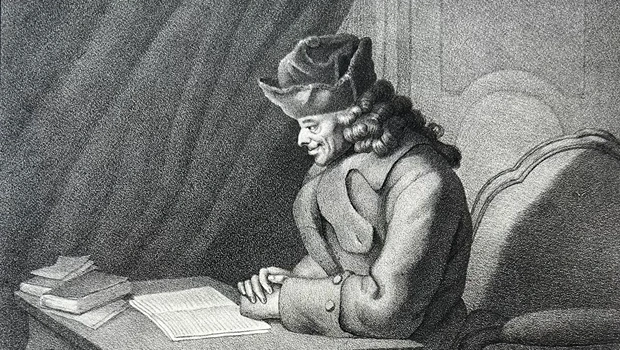
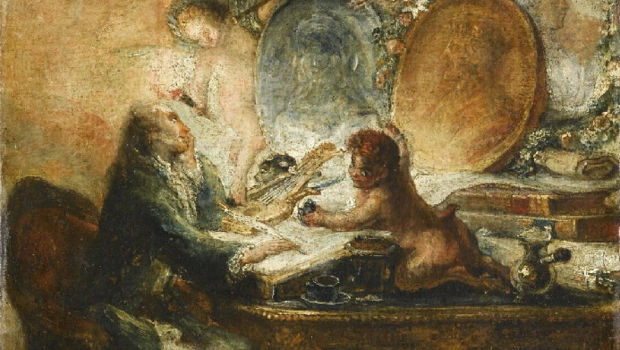
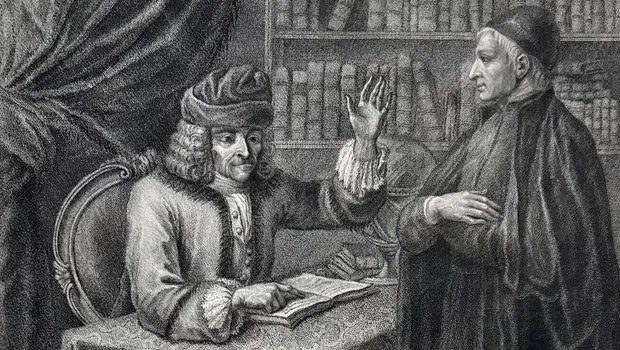
Voltaire Iconography is the first critically annotated digital database dedicated to the visual representations of Voltaire. Spanning engraving, painting, sculpture and the decorative arts, the project brings together works from across Europe, dating from the earliest known likeness (1718) to the end of the Bourbon Restoration (1830).
The database builds on an extensive analogue archive generously donated to the Voltaire Foundation by Professor Samuel Taylor. It features reproductions of a wide range of objects — from canonical portraits by Nicolas de Largillière, Maurice Quentin de La Tour, Jean Huber, Jean-Antoine Houdon and Jean-Baptiste Pigalle to lesser-known artefacts such as caricatures, playing cards, board games and porcelain figurines.
By consolidating this dispersed material for the first time, the project offers a powerful tool for tracing the evolution of Voltaire’s image across time, media and cultural contexts. It brings together a body of scholarship that has long remained fragmented and sheds light on works that have received little or no academic study.
Voltaire’s Image
François-Marie Arouet (1694–1778), better known as Voltaire, was not only a central figure of the European Enlightenment but also one of the first internationally recognised celebrities. His image circulated widely during his lifetime and after his death, extending far beyond literary circles of Europe’s major capitals.
Portraits of Voltaire appeared in a remarkable range of contexts : as frontispieces in printed works, engravings displayed in domestic interiors, sculpted busts on mantelpieces, and decorative motifs on everyday objects such as clocks, snuff boxes, bonbonnières, tea services, pipes and textiles.
This exceptional visual presence makes Voltaire’s iconography a particularly rich field of study, offering insights not only into the construction of his own public persona but also into the broader dynamics of image-making and celebrity in the eighteenth and early nineteenth centuries.
Using the Database
Search and Explore
The explore page allows full-text searching across titles, artist names, places of creation, inscriptions and bibliographic references. Users can also refine results by applying filters, which include date, object type, place of creation, artist, themed collection, features and people represented.
Individual Entries
Each entry includes:
- an image
- copyright information
- technical metadata (artist, date and place of creation, object type, materials, dimensions, current location, inventory number and collection link)
Additional metadata identifies what is represented in the image:
- inscriptions
- features (attributes, objects, and motifs)
- people represented
- related works and letters by Voltaire
Related items, such as copies, preparatory drawings and variants, are grouped in the “related objects” section, with links to external collections, where applicable.
Each entry also brings together relevant bibliography, including art-historical studies, exhibition catalogues and primary sources.
Themed Collections
Entries are organised into curated thematic collections exploring different aspects of Voltaire’s visual legacy. These collections combine art-historical commentary providing historical context with iconographic analysis, alongside carefully selected groups of objects. The collections to which each work belongs are listed at the bottom of its record.
Within Oxford University Voltaire
Voltaire Iconography forms part of the wider Oxford University Voltaire digital ecosystem, complementing the digital edition of Voltaire’s complete works. Cross-resource searches can be conducted via the central platform, and individual entries include links to Voltaire’s writings and correspondence, as well as to shared compendium records for people and places.
Future Development
This database is an ongoing project. Future work will focus on incorporating newly identified works within the 1718–1830 timeframe, refining metadata, and developing additional themed collections. Users are warmly encouraged to contribute by reporting errors or sharing information via the “Report an error” form.
Professor Samuel Taylor
This project was initiated by Professor Samuel Taylor and is rooted in the extensive research he conducted in the 1980s and 1990s. One of the leading Voltaire scholars of his generation, Taylor completed his PhD at the University of Birmingham in 1957 on the Voltaire–Rousseau quarrel. He subsequently served as Theodore Besterman’s research and editorial assistant at Les Délices (1960–63), contributing to the final volumes of the Voltaire Correspondence, and later held a professorship in French at the University of St Andrews. His archival research led to the publication of Voltaire’s handwritten revisions to the encadrée edition in St Petersburg. In later years, he assembled a comprehensive corpus of portraits of Voltaire, which now forms the basis of the Voltaire Iconography.
To learn more about Professor Samuel Taylor and the history of the project, follow this link.
Acknowledgments
We gratefully acknowledge the generous financial support of the Astra Foundation, the British Academy, and St Edmund Hall.
We are equally indebted to the many individuals and institutions whose expertise, generosity, and collaboration made this resource possible, including:
Professor Samuel Taylor; Jennifer Montagu; Margaret Goudie; Josie Dyster; Garry Apgar; Flávio Borda D'Água (Les Délices, Geneva); Ana Lezan (Domaine de Chaalis); Ulrike Polnitzky (Austrian National Library); Klaus Vondrovec (Muntzkabinett, Kunsthistorisches Museum, Vienna); Mike Webb (Bodleian Libraries); Wassili Joseph (Musée des Beaux-Arts de Rouen); Marion Ortiz, Sophie Motsch, Astrid Grange, Sonia Aubès and Jean-Luc Olivier (Musée des arts décoratifs, Paris); the Département des arts graphiques du Louvre; Véronique Guasco, Lara Cavallo and Christine Vivet-Peclet (Musée national de Céramique, Sèvres); Florent Picouleau (Château de Chantilly); Sarah Chapalay, Eloi Contesse, Sonia Manaï and Monika Sirisin (Centre d’iconogrphie de la Bibliothèque de Genève); Sylvie Costa Paillet (Musée historique, Lausanne); Sarah Dupont (Château de Voltaire, Ferney); Aneta Czarnecka, Krystyna Mikucka-Stasiak and Emma Żuchowska (Muzeum Łazienki Królewskie, Warsaw); Christian Jäger, Jekaterina Klassen, Mailena Mallach (Kupferstichkabinett, Berlin); the SINDBAD team of the Bibliothèque nationale de France; Maria Borisenkova, Inga Lander, Natalia Speranskaya (National Library of Russia, Saint Petersburg).
We are also deeply grateful to the museums, libraries, archives, auction houses, and other collections that kindly granted permission for the reproduction of works from their holdings free of charge:
Bibliothèque nationale de France; Les Délices, Geneva; Musée de l'Abbaye royale (Musée Jacquemart-André), Chaalis; Musée d'art et d'histoire, Geneva; Bibliothèque de Genève; Royal Library of Belgium; Musée des Beaux-Arts d’Angers; Musée des Beaux-Arts de Caen; Comédie-Française, Paris; Musée des Beaux-Arts de Rouen; Berlin State Library; Musée des Beaux-Arts de Dijon; Château de Sceaux; Musée des Beaux-Arts de Dole; Musée des Beaux-Arts de Troyes; Musée des Beaux-Arts et d'Archéologie de Besançon; Allen Memorial Art Museum, Oberlin OH; Lewis Walpole Library, Farmington; Ashmolean Museum, Oxford; Waddesdon Manor; New York Historical; Rouillac; Herbette; L'Huillier & Associés; Sworders Fine Art Auctioneers; Düsseldorfer Auktionshaus; Marambat - de Malafosse; Phidias; De Zwaan Amsterdam; De Baecque et Associés, Muizon - Rieunier; Artcurial; 68 Art Auction; Cella Antiques; Litfund Auction House; Koller Auktionen; Musée Estrine, Saint-Rémy-de-Provence; Museum of the French Revolution, Vizille; American Antiquarian Society, Worcester; Royal Museums of Fine Arts of Belgium, Brussels; Musée des Arts Décoratifs, Paris; Musée Biochet-Bréchot, Caudebec-en-Caux.
This resource is supported by the United Grand Lodge of England in recognition of the strong connection between Freemasonry and Enlightenment values.
Copyright notice
Unless otherwise stated, the Voltaire Foundation does not hold the copyright to the images reproduced in this database. For permission to reproduce or reuse an image, please contact the relevant holding institution.